
Tap, Chip, and Go: How Card Readers Prevent Chargebacks and Protect Your Business (2026 Guide)
In 2026, running a profitable business isn’t just about making sales — it’s about keeping the revenue you earn. For small and medium-sized businesses, chargebacks have quietly become one of the biggest threats to the bottom line. And yet, most of them are entirely preventable with the right secure payment processing for businesses.
The solution starts at the point of sale. Modern card readers that prevent chargebacks — built around chip, tap, and contactless technology — are no longer a luxury. They’re the foundation of a fraud-resistant, dispute-proof payment system.
Did you know? According to Mastercard, global chargeback volumes are expected to exceed 337 million transactions by 2026, costing merchants an estimated $117 billion annually.(Source: Mastercard Chargeback Guide — Official PDF) )
This guide breaks down everything you need to know — from what chargebacks actually are, to how the right technology stops them before they start.
Key Takeaways
- Chargebacks cost merchants far more than just the sale — fees, penalties, and a rising dispute rate can seriously damage your business over time.
- Friendly fraud is the biggest threat — accounting for up to 70% of all chargebacks. Most of the time, it’s preventable.
- Swipe is a liability in 2026. If a customer presents a chip card and you swipe it, the fraud loss is yours to absorb — no exceptions.
- Chip and tap payments shift the liability away from you. EMV compliance and NFC tokenization are your strongest built-in defenses against fraud.
- The right payment processor matters. Real-time fraud detection, chargeback alerts, and dispute support aren’t extras — they’re essentials.
- Speed saves money. Responding to a customer complaint within 24 hours is one of the simplest and most cost-effective ways to stop a chargeback before it starts.
- Small habits make a big difference — clear billing descriptors, transparent policies, and trained staff can eliminate a surprising number of disputes overnight.
What Is a Chargeback?
The Fair Credit Billing Act of 1974 gave consumers the right to dispute unauthorized credit card transactions. It also protects them when they don’t receive what they paid for. The chargeback is the primary tool that makes this possible.
A chargeback allows cardholders to dispute a transaction directly with their issuing bank — there’s no need to seek a refund from the merchant. Each chargeback carries a reason code that explains the nature of the dispute.
The system was designed to shield consumers from bad actors. However, it is frequently used — and occasionally abused — at the merchant’s expense.
The Three Types of Chargebacks
True Fraud occurs when a transaction is made without the cardholder’s knowledge or authorization. This is the most legitimate form of a chargeback dispute.
Merchant Error happens when a merchant fails to fulfill their end of the purchase agreement — such as not delivering a product or providing a faulty service.
Friendly Fraud refers to chargebacks filed on false or inaccurate grounds. Despite its name, this type is anything but friendly — especially for merchants.
Stat: Major card networks estimate that as much as 70% of all credit card fraud can be traced to chargeback misuse — commonly known as friendly fraud — an issue that merchants report has increased nearly 20% over the last three years. Yahoo Finance
(Source: Chargebacks911 — 2024 Chargeback Field Report)
Common Reasons for Chargebacks
Understanding why chargebacks happen is the first step toward preventing them. Here are the most frequent triggers:
Unauthorized or Fraudulent Transactions — A stolen or cloned card used at a merchant’s terminal without the cardholder’s knowledge. One of the most serious and common chargeback triggers.
Friendly Fraud — A customer receives their order but claims they never did. Or they simply don’t recognize the business name on their statement and file a dispute out of confusion.
Duplicate Charges — Technical glitches caused by outdated hardware that accidentally bills a customer twice for one purchase.
Product or Service Disputes — The customer claims the item arrived damaged, defective, or didn’t match its description.
Why Chargebacks Are Dangerous for Small Businesses
Getting a chargeback is never just a one-time problem. It triggers three separate consequences — and each one stings in its own way.
You lose the sale. The transaction amount is taken back entirely. For small businesses operating on tight margins, even a handful of chargebacks each month quietly chips away at profitability.
You get hit with a fee. Your payment processor automatically charges a penalty — typically between $20 and $100 — every time a chargeback is filed. Win or lose the dispute, that fee still applies.
Your chargeback rate climbs. This metric tracks the percentage of your total transactions that end in disputes. Once it crosses 1%, card networks like Visa or Mastercard can force you into a costly chargeback mitigation program — one that’s expensive, time-consuming, and disruptive to daily operations.
Stat: The true cost of a chargeback is often 2.5x the original transaction value when you factor in fees, lost merchandise, and administrative time. (Source: LexisNexis True Cost of Fraud Study)
Swipe vs. Chip vs. Tap: Which Is Safer for Your Business?
This is one of the most important questions any merchant can ask — because the answer directly affects your fraud prevention payment system and your liability exposure.
Swipe (Magstripe) — The Riskiest Option
Swiping a card might feel familiar, but it’s the least secure payment method available today.
The magnetic stripe stores fixed data that never changes — making it incredibly easy for fraudsters to use skimming devices that silently copy card information and create cloned cards.
Under current EMV chip card protection regulations, if a customer presents a chip card and you process it as a swipe, the fraud liability falls entirely on you. The card network won’t cover it.
Risk Level: High — Magstripe transactions carry the highest fraud rate of any payment method.
Chip (EMV) — The Smarter, Safer Step Up
Chip and PIN vs swipe security isn’t even a close comparison. EMV chips generate a unique, one-time transaction code for every single purchase. Even if a fraudster intercepts that code, it’s completely useless — it expires the moment the transaction is completed.
For merchants, the liability shift works in your favor. Banks generally cover the cost of fraud on chip-verified transactions.
Security Level: Strong — Dynamic transaction codes make chip cards significantly harder to compromise.
Tap to Pay (Contactless/NFC) — The Gold Standard
Tap to pay security benefits go beyond what chip technology alone offers.
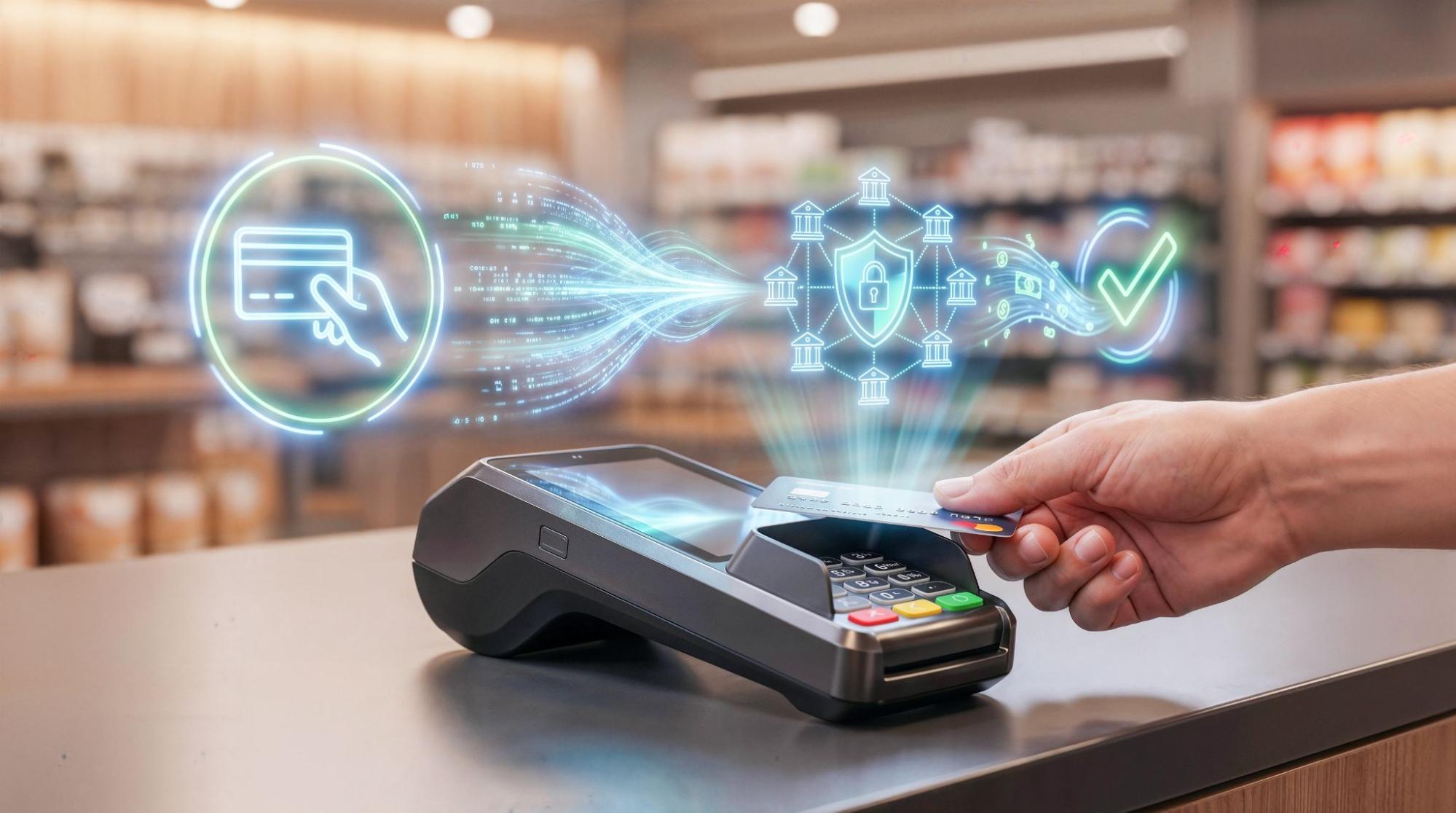
Using NFC technology, the payment terminal and the customer’s card or phone exchange a randomized token — not the actual card number. That token is temporary and meaningless outside that single transaction.
The result is the same strong encryption as a chip card, with an additional layer of tokenization — and a noticeably faster checkout experience.
Security Level: Highest — Contactless payment fraud protection through tokenization ensures real card data is never exposed.
How Modern Card Readers Prevent Chargebacks
How chip card readers reduce fraud and chargebacks comes down to one thing — layers. Each layer of protection closes a gap that fraudsters and disputing customers would otherwise exploit.
1. EMV Chip Technology — Your First Line of Defense
The single biggest reason to upgrade to a chip-enabled reader is the liability shift.
When you process a payment through an EMV-compliant terminal, you’ve fulfilled your duty as a merchant. If fraud still manages to slip through, the responsibility shifts to the issuing bank — not you. For any merchant serious about how to reduce chargebacks in retail, EMV compliance is the essential starting point.
2. Contactless Payment Fraud Protection Through Tap-to-Pay
When a customer pays via Apple Pay or Google Pay, the transaction requires biometric authentication — Face ID or a fingerprint scan — directly on their device. So it is nearly impossible for a customer to later claim the transaction was unauthorized. Their own biometric signature approved it. That’s one of the most powerful defenses against friendly fraud available today.
3. End-to-End Encryption (E2EE) — Keeping Data Out of the Wrong Hands
From the moment a card is tapped or inserted, sensitive data is encrypted immediately. It stays encrypted throughout the entire transaction journey — never visible to your local network, never vulnerable to malware.
This is a core component of any serious fraud prevention payment system.
4. AI-Powered Fraud Detection — Catching Problems Before They Become Chargebacks
Modern POS system chargeback protection goes beyond hardware. Built-in AI monitoring tools examine every transaction in real time — comparing it against the cardholder’s typical behavior. Anything unusual gets marked immediately, prompting subjective evaluation before the sale is completed.
5. Work With a Payment Processor That Actually Has Your Back
Not all processors offer the same level of POS system chargeback protection. Look for a provider that includes:
Fraud Detection Software — Real-time monitoring that catches suspicious behavior before it becomes a chargeback.
Chargeback Alerts — Instant notifications that give you the window to resolve a dispute directly with the customer before it escalates.
Dispute Management Support — Hands-on guidance to help you respond, gather evidence, and fight back with confidence.
Best POS Systems to Prevent Chargebacks — What to Look For
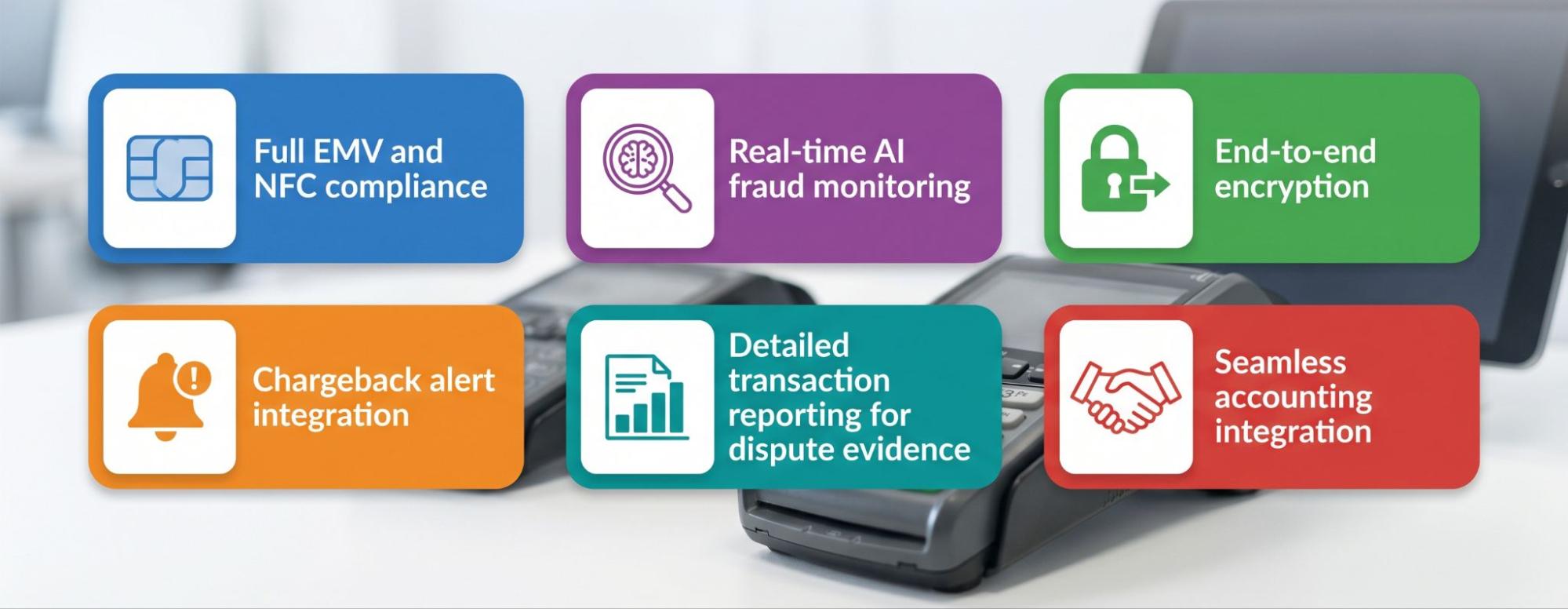
When evaluating a small business payment security solution, these are the non-negotiable features:
Benefits of Modern Card Readers for Your Business
Investing in a modern card reader is about more than just accepting payments — it’s about building a more secure, efficient, and customer-friendly business.
- Get Paid From Any Location: Easily accept payments at events, temporary shops, or customer locations.
- Safer Than Carrying Cash: Modern readers are EMV-compatible and integrate with accounting platforms, eliminating cash handling risks and simplifying reconciliation.
- Fast Checkouts, Accurate Records: Transactions process in seconds. Digital receipts are sent instantly — creating a clean record of every sale.
- NFC Payment Security Is Now the Norm Today’s card readers allow customers to pay with a tap — no touching, no swiping, no friction. Payments are transmitted, authenticated, and verified securely in an instant.
- A Better Customer Experience: Mobile card readers let staff check out customers anywhere on the floor — reducing wait times, increasing engagement, and creating upsell opportunities.
- Smarter Management Tools: Real-time inventory updates, sales dashboards, and integrated reporting — everything in one place.
Chargebacks Are Preventable — Here’s How
Most chargebacks don’t come out of nowhere. They’re usually the result of a miscommunication, a frustrating experience, or a gap in how payments are handled. Nearly all of them can be avoided with the right habits.
- Make It Easy for Customers to Come to You First: Keep contact information visible. Display return and refund policies clearly. Walk customers through the process step by step.
- Keep Your Policies Clear and Simple: Write in plain language. Don’t use legal jargon. Make policies easy to find and easy to understand.
- Train Your Team to Spot Fraud Early : Teach staff on common fraud warning signs. Keep training regular — fraud tactics evolve constantly.
Having a trained team is important — but the right tools make their job significantly easier.
- Use the Right Fraud Prevention Payment System Tools
Address Verification Service (AVS) — Cross-checks billing addresses against bank records. Any mismatch is flagged immediately.
CVV Verification — Confirms the customer physically has the card in hand during online purchases.
3D Secure Authentication — Requires a secure PIN before any transaction is approved. No PIN, no payment.
- Respond Quickly — Before It Escalates Acknowledge every complaint within 24 hours. Process refunds without delay. Follow up after resolution. The faster you respond, the less likely a frustrated customer becomes a lost one.
- Make Your Billing Information Recognizable: Maintain your business name on statements that match your brand exactly. Confusion about an unfamiliar charge is one of the most common — and most preventable — chargeback triggers.
How Does Patel Processing Has Your Back?
Running a business is hard enough without worrying about fraud and chargebacks eating into your revenue. Patel Processing exists to make sure every transaction works in your favor.
Hardware That Actually Keeps Up With You: Our POS systems are built for speed, reliability, and full EMV and NFC compliance — every transaction goes through cleanly and securely.
Fraud Caught Before It Becomes Your Problem: Our fraud detection software works quietly in the background. Analyzing every transaction and flagging anything unusual before it reaches your account.
A System That Fits Around Your Business: You run a restaurant, retail shop, or mobile service — our systems are customized to fit your workflow without friction.
Every payment processed through Patel Processing leaves a clear, verifiable trail — your strongest argument when fighting a chargeback.
FAQs
- What is the most common cause of chargebacks for small businesses?
Friendly fraud is the leading cause — accounting for up to 86% of all chargebacks. This occurs when a customer disputes a legitimate transaction, either out of confusion or intentional deception.
- Does using an EMV chip reader really reduce chargebacks?
Yes — significantly. EMV chip readers trigger a liability shift that protects merchants from absorbing fraud losses on chip-verified transactions. Banks cover the cost instead.
- Why is tap to pay safer than swipe payments?
Tap-to-pay uses tokenization and biometric authentication — meaning the real card number is never shared and the transaction requires the customer’s physical approval. Swipe transactions store static data that can be easily copied and cloned.
- What happens if my chargeback rate exceeds 1%?
Card networks like Visa and Mastercard can place you in a chargeback monitoring program — which comes with higher processing fees, additional penalties, and in severe cases, termination of your merchant account.
- What is NFC payment security and how does it work?
NFC (Near Field Communication) allows two devices to exchange encrypted data within a few inches of each other. Instead of sharing real card data, a randomized token is used — making interception pointless for fraudsters.
- How quickly should I respond to a customer dispute?
Within 24 hours where possible. The faster you approach a complaint directly, the less likely it grows into a formal chargeback. Speed of response is one of the most underrated chargeback prevention tools available.
- What should I look for in the best credit card processing for fraud prevention?
Look for EMV compliance, NFC support, real-time AI fraud monitoring, end-to-end encryption, chargeback alerts, and detailed transaction reporting — all of which Patel Processing provides.
The Bottom Line
No business owner wakes up expecting a chargeback. But they happen — and more often than not, they happen because the right systems weren’t in place to prevent them.
The shift to chip and tap payments isn’t just about keeping up with technology. It’s about protecting the revenue you’ve worked hard to earn, giving your customers a checkout experience they can trust, and making sure fraud never gets the foothold it needs to hurt your business.
In 2026, the tools to do all of this are more accessible than ever. The only question is whether you’re using them.